
The True Purpose of Mosques: Worship, Compassion and Justice
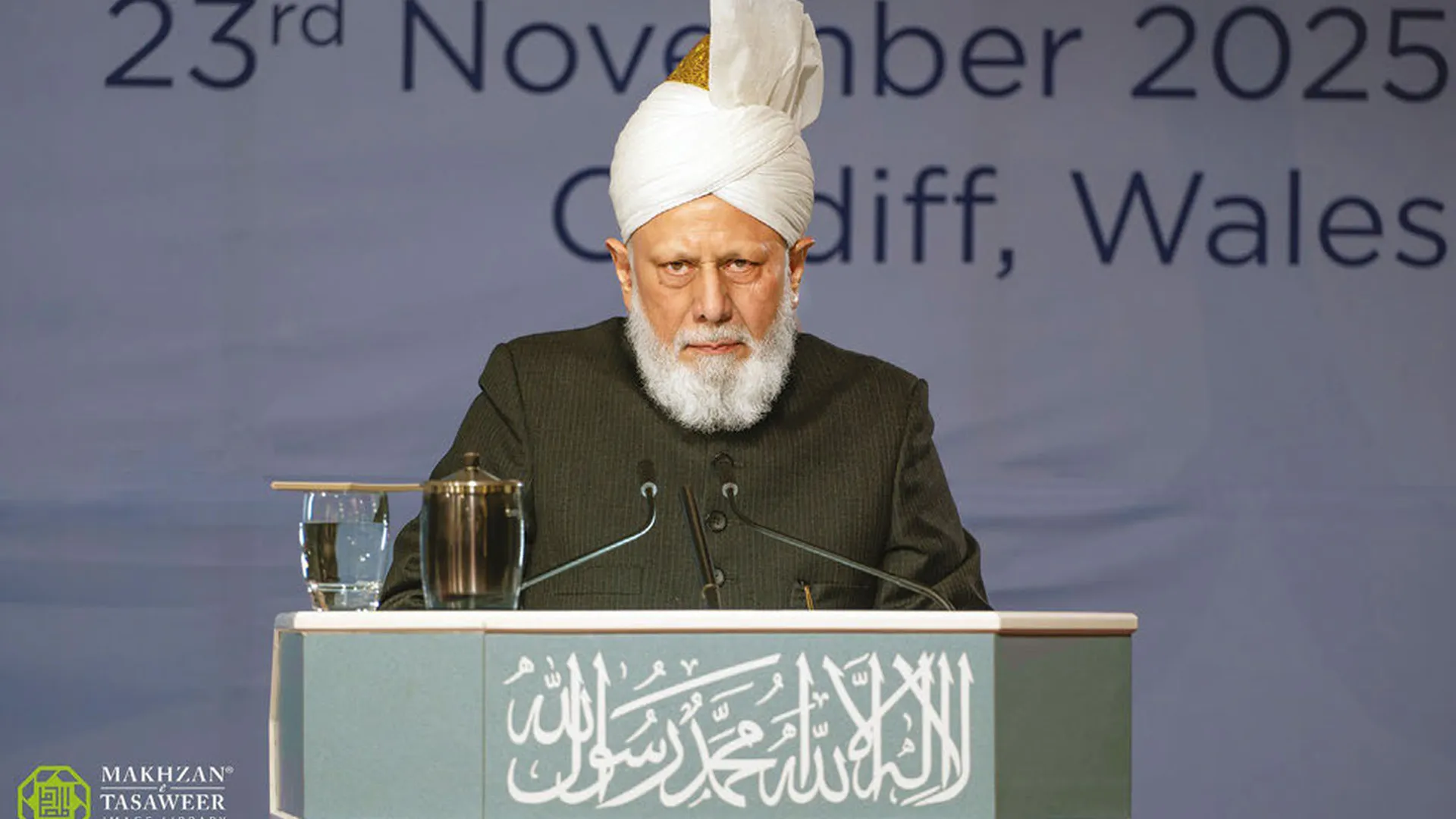
Official Transcript of the Keynote Address by Hazrat Mirza Masroor Ahmad (aba), Worldwide Head of the Ahmadiyya Muslim Community, Fifth Khalifah of the Promised Messiah (as), at the Ijtema of Bait-ur-Rehman Mosque, Cardiff, Wales on 22nd November 2025.
The Purpose of Mosques
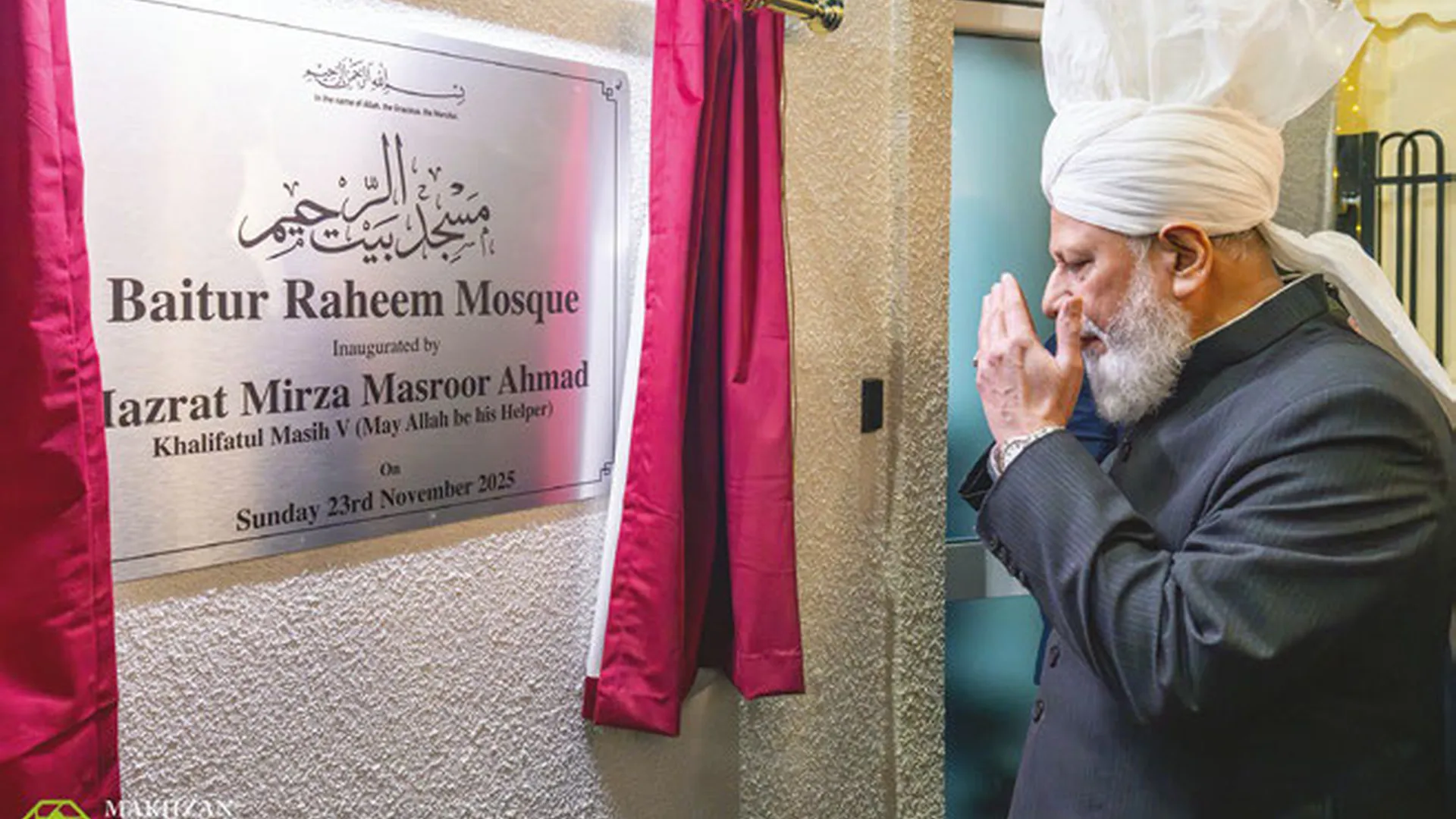
After reciting Tashahhud, I’uz and Bismillah, the Worldwide Head of the Ahmadiyya Muslim Community began his address by welcoming all of our respected guests and pointing to the true inauguration of this mosque. Huzoor affirmed that mosques are built for the worship of God, and the true purpose of this mosque is to serve our neighbours and the local community.
Indeed, the abiding message that a mosque must convey to all who see it is a place of values and accepted when aligned with service to humanity. This is a foundational principle of Islamic teaching.
The Qur’anic Guidance on Moral Choice
In this vein, Allah declares that He has clearly laid out for man what is right and wrong. For example, in chapter 90, verse 11 of the Holy Qur’an, Allah the Almighty says:
“And We have pointed out to him the two highways of good and evil.”
In this verse, Allah declares that He has clearly laid out what is right and what is wrong. Huzoor noted that Allah has blessed man with the ability to choose the right path, and yet a person who consistently chooses the wrong path finds himself at a lower spiritual level. The Almighty has bestowed upon mankind a moral compass to guide us, with the ability to reason, to distinguish the wrong path from the right path, and to choose what is righteous.
Upholding the True Purpose of Mosques
Thus, the true purpose of a mosque, as the Holy Prophet Muhammad (sa) taught, is a place where Muslims gather to fulfil their religious obligations, and to build unity and harmony. The mosque should not be used to sow discord, disorder, or division. When used for its true purpose, the mosque becomes a centre of peace, love and harmony, and fosters the unity of the community throughout the Muslim world.
Worship Paired with Fulfilling the Rights of Others
The true mean that God enjoins upon every Muslim is that their worship and acts of devotion must also be accompanied by fulfilling the rights of others. People who are ostentatious in their worship before God are insincere and hypocritical in the sight of God. The Qur’an describes them as those who deny religion.
On the other hand, a person whose motivation is to help those in genuine need — the true poor and vulnerable amongst us — is someone whom God values amongst the very highest. Such a person strives to fulfil the revolutionary instruction that Islam gives to help people in desperate need.
Exploiting Exploitation of the Vulnerable
The Qur’an has clearly laid out what is right and wrong. If a person ignores God’s moral compass and follows the path of self-interest, they will gradually deviate from the right path and their moral decline will be progressive. Such wrongdoing is amongst the worst form of slavery — a slavery that emerges not from outside but from within, born of a person’s inner moral corruption.
One might wonder if the spirit of slavery could be found in today’s world. The answer is yes — it manifests in various forms of exploitation, indifference, and injustice that persist across societies.
Social Welfare and Caring for the Vulnerable
The Qur’an’s instruction on social care instructs Muslims to free the enslaved, feed the hungry, and clothe the needy. It commands Muslims to support orphans who are near or distant relatives, and to support the widowed, the orphaned, and others who suffer from hardship. The companions strove to ensure that the weaknesses of society were lifted so that the foundations of peace could be established.
The Universal Applicability of Qur’anic Teachings
The commandments given by the Qur’an are universally applicable. The Ahmadiyya Muslim Community does not just limit its efforts to its own members — it reaches out beyond its boundaries to support those in need regardless of faith, ethnicity, or background. The Humanitarian Aid and Charity supporting local food banks, and the Humanity First organisation working across the world, are expressions of this commitment.
A Comprehensive Code of Moral Values
In chapter 5, verse 97 of the Holy Qur’an:
“And truly Allah enjoins justice and the doing of good and giving to the kindred, and He forbids indecency and wickedness and transgression. He admonishes you so that you may take heed.”
This verse instructs Muslims to show kindness to the poor and vulnerable and all who need assistance, whether they have faith or not. Muslims are commanded to always be kindly and equitable to all people they deal with.
Educational and Social Projects of the Ahmadiyya Muslim Community
The Ahmadiyya Muslim Community does not just preach — we practise it. Our schools built in the developing world provide opportunities without distinction. We provide access to clean drinking water through our water projects, medical support through our hospitals and clinics, and have established orphanages providing shelter, love, and education to those without parents.
We believe that service to humanity is, in reality, service to God.
Obedience to the Law and Serving the Nation
The Holy Qur’an strongly instructs Muslims to obey the laws of the land in which they live. When living in a non-Muslim state, Muslims must still obey the law and adhere to its values and customs — paying taxes, respecting courts and governments, and not involving themselves in revolutionary elements. We have an inseparable bond with this country and will serve it with kindness and love.
A Mosque’s Duty as a Beacon of Light and Peace
This mosque will prove itself a beacon of light. It will become a place of peace, love, and service. Insha’Allah, it will serve your needs and will do much for the community. It will enable the people in your local area through service, action, and prayer.
A mosque built on sincere values will in time fulfil the requirements of worshipping Allah, while also spreading goodness to all people around.
A Closing Note of Thanks and Prayers
With these words, I wish to once again sincerely thank all of you for being here. I pray that we are able to live up to the teachings of Islam that I have outlined today.
I pray that we may all be blessed with peace, and that Allah fills our lives with peace and happiness. Ameen.
Originally published in the Review of Religions